A diagnosis from a photo
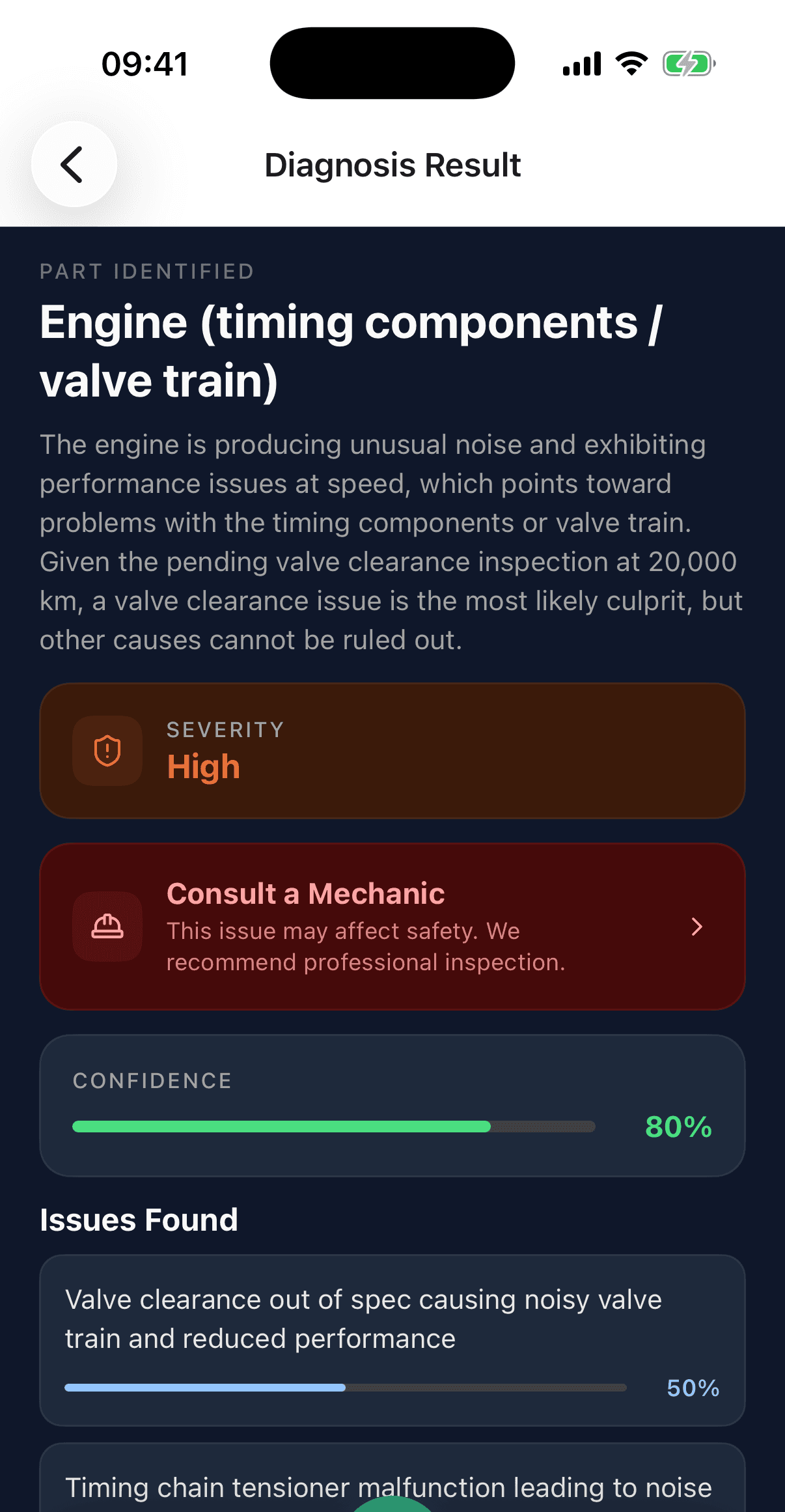
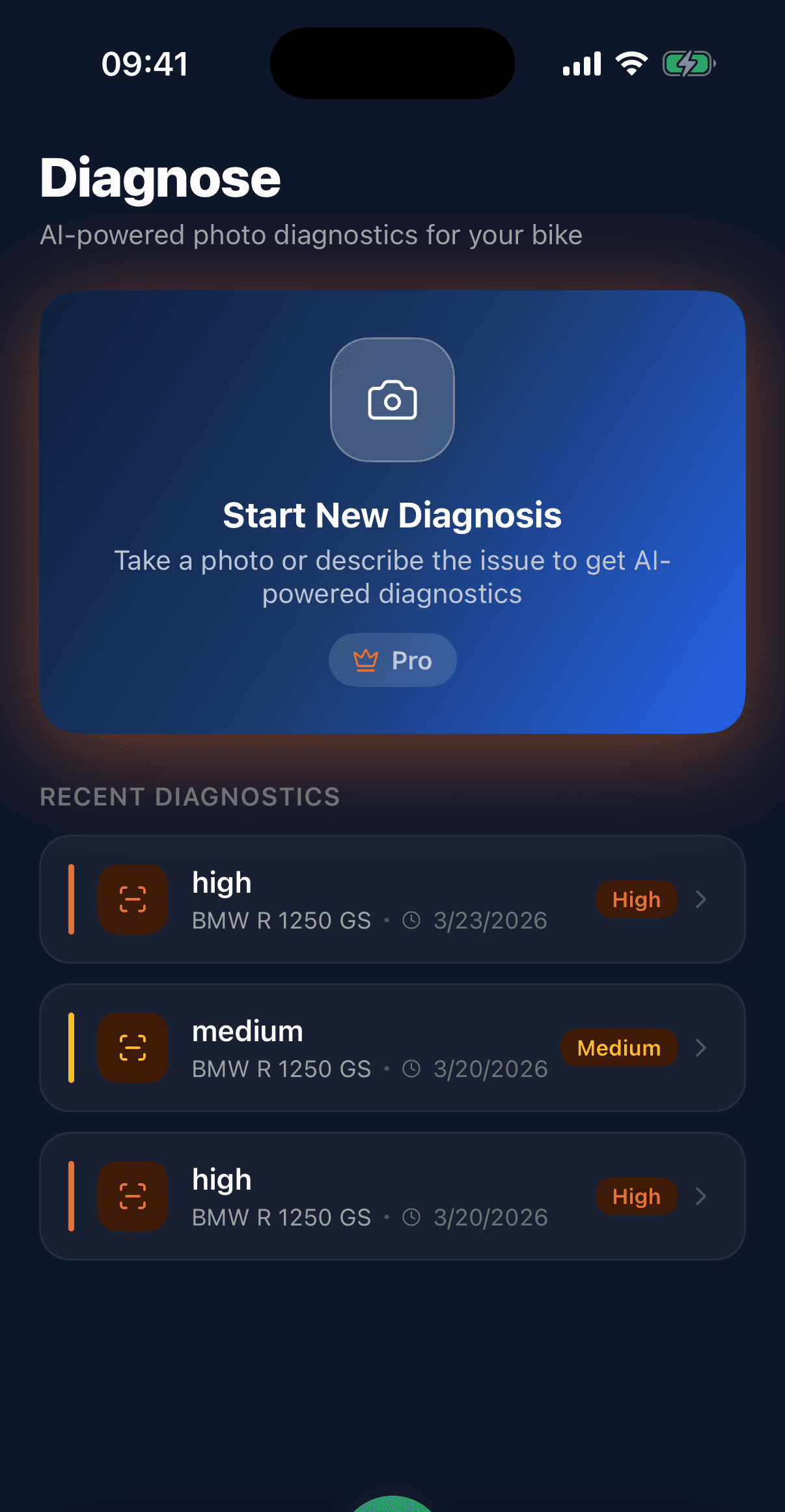
Photograph a part, a warning light or a symptom; the app names the likely issue, its severity, a confidence level and the next step.
What it can diagnose
Warning lights & dashboard symbols
Engine & mechanical issues
Electrical system problems
Brake & suspension wear
Chain & drivetrain condition
Tire wear & pressure issues
Fluid leaks & levels
Corrosion & body damage
How a diagnosis works
Select your motorcycle
Pick from your garage or enter bike details manually. The AI tailors its diagnosis to your specific make, model, and year — because a chain noise on a Ducati dry-clutch means something different than on a Honda CB500.
Describe the problem
Select symptoms, pinpoint the location on your bike, and tell us when it happens — at idle, at speed, cold start, hot engine. A guided wizard ensures nothing gets missed.
Add a photo and details
Get a clear, well-lit photo of the affected area. Add notes, recent observations, and set urgency — from routine preventive check to roadside emergency.
Review and submit
Confirm your details, optionally share maintenance history for deeper context, and submit. The AI cross-references known issues for your model, service bulletins, and wear patterns.
Get your diagnosis
Receive a structured diagnosis: part identification, severity rating, confidence score, probable causes with percentages, required tools, difficulty level, and step-by-step next actions.
What a diagnosis looks like
A sample result for a chain that has gone slack. Every diagnosis is saved to the bike's record, so the next time the same symptom shows up you can see what you did about it.
Chain tension too loose
Slack measures ~45mm. Adjust to 25–35mm at the rear axle pivot. Estimated 8 minutes with standard tools.
- Chain stretched past its service limit60%
- Adjusters set unevenly after the last wheel removal25%
- Worn rear sprocket15%
- Tools
- Rear axle wrench, ruler, torque wrench
- Difficulty
- Easy · about 15 minutes
- Next step
- Set the slack to 25–35 mm at the tightest point of the chain, then check the alignment marks on both sides and torque the axle nut.
How AI motorcycle diagnostics works
Motorcycle diagnostics has traditionally been the domain of experienced mechanics with specialized tools. MotoVault changes that by putting AI-powered diagnostic capabilities directly in your pocket. Whether you are a seasoned rider who has been wrenching for decades or a new rider who just bought their first bike, MotoVault's AI diagnostics helps you understand what is happening with your motorcycle — quickly, accurately, and without expensive equipment.
From photo to diagnosis
A vision model reads the photo, identifies components and wear patterns, and reasons about them for your specific make, model and year. Severity runs from minor to critical, and every result carries a confidence level: it is a first opinion, not a verdict. The bike catalogue covers every make, model and year in the official NHTSA vehicle database.
Real-world diagnostic examples
Riders use MotoVault diagnostics in countless real-world scenarios. A rider notices a puddle under their parked bike — they snap a photo and MotoVault identifies it as a coolant leak from the water pump seal, rated as moderate severity with a recommendation to replace the seal before the next long ride. Another rider sees a dashboard warning light they do not recognize — a quick photo identifies it as a lean fuel mixture indicator, likely caused by a dirty air filter. A new rider inspecting their used purchase photographs the chain — MotoVault detects excessive stretch and worn sprocket teeth, recommending a full chain and sprocket replacement. These are the kinds of everyday situations where having an AI mechanic in your pocket saves time, money, and prevents breakdowns.
AI diagnostics vs. traditional tools
Traditional motorcycle diagnostics relies on OBD2 scanners (limited to newer bikes with compatible ports), multimeters for electrical testing, and the trained eye of an experienced mechanic. MotoVault does not replace these tools — it gives you an accessible first opinion. Where an OBD scanner reads stored error codes, MotoVault sees problems that have no error code: worn brake pads, corroded terminals, leaking fork seals, or a chain that needs adjustment. Each result carries a confidence level, so you know how much weight to give it. The result is a more informed decision about your motorcycle — whether you fix it yourself or take it to a shop with a clear description of the problem.
Questions, answered
How does AI motorcycle diagnostics work without OBD?
MotoVault uses advanced photo-based diagnosis powered by AI. Simply take a photo of the issue or describe your symptoms, and our AI analyzes the image to identify components, detect wear patterns, spot fluid leaks, and assess damage severity. Unlike OBD scanners that read error codes through a port, MotoVault uses visual recognition — meaning it works on every motorcycle regardless of age or make, with no adapters or cables required.
What motorcycle problems can MotoVault diagnose?
MotoVault can diagnose a wide range of issues including engine problems (overheating, oil leaks, unusual noises), electrical system faults (dead batteries, faulty wiring, blown fuses), brake wear and pad thickness, tire condition and tread depth, suspension leaks and sag, chain tension and sprocket wear, fluid leaks and contamination, corrosion and body damage, and dashboard warning lights. Each diagnosis includes a severity rating so you know what needs immediate attention.
Is AI motorcycle diagnostics accurate?
Every result carries a confidence level. Treat it as a first opinion: it tells you what the problem most likely is and what to check next. Confirm anything safety-critical — brakes, steering, structural damage — with a mechanic before you ride.
Do I need special equipment for AI diagnostics?
No special equipment is needed — just your smartphone camera. MotoVault is designed to work with the camera already in your pocket. Take a clear, well-lit photo of the part or issue, and the AI handles the rest. No OBD adapters, no Bluetooth dongles, no proprietary tools. This makes MotoVault accessible to every rider regardless of technical experience or budget.
How is MotoVault different from OBD2 scanners?
Traditional OBD2 scanners only work on bikes with an OBD port (mostly newer models), require a physical adapter, and can only read stored error codes. MotoVault works on any motorcycle — vintage, modern, carbureted, or fuel-injected — because it uses visual AI analysis instead of electronic port reading. It can identify problems that OBD scanners miss entirely, such as physical wear, corrosion, fluid leaks, and tire condition. Plus, MotoVault provides plain-language explanations instead of cryptic error codes.
Start the logbook before the next ride.
Free on iOS and Android. Maintenance, expenses and rides, one record per bike.